
Shifting Together
Bridging the inner and outer dimensions

I want to dedicate this article to Arawana Hayashi. I had many mentors in my life, and yet her generous teaching of humbleness and kindness in movement shines the brightest. It is precious when someone you admire can see you and your true potential more clearly than you can.
May this article encourage you to let the mentor who sees who you might become, find you.
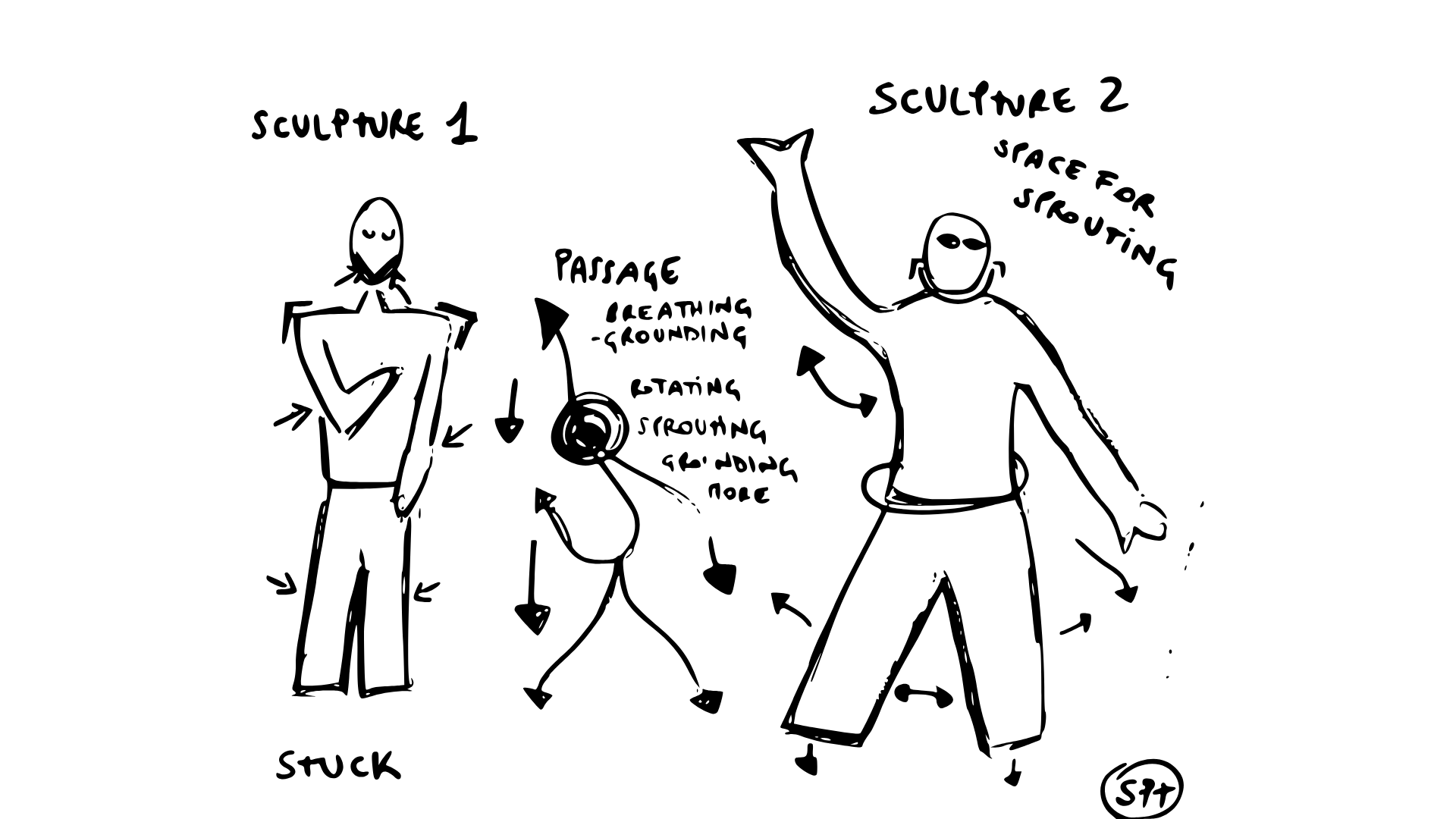
Stuck is the name of a Social Presencing Theatre (SPT) practice in which we embody and sense into our experience of “stuckness” to enable the noticing of emerging possibilities. As Arawana Hayashi writes in Social Presencing Theatre: The Art of Making a True Move, the practice invites us to let go of habitual patterns and can give us a felt sense of emerging possibilities.
“The Stuck practice asks us to stay with the feeling but to let go of our past stories about the situation—what we know—so that we might move toward what we do not know, embodied in a second body shape, Sculpture 2. We open ourselves to a future that wants to emerge through us.” (Hayashi, 2021)
“By intensifying and staying with that stuck shape, we contact the yearning embodied in the shape to move toward a next step. Stuck wants to move. However, this is not a problem–solution method. Sculpture 2 is not ‘unstuck,’ as in a solution to a problem. Sculpture 2 offers a sense of what a next step might be in the journey. It can reveal an insight, a message, a knowing that we do not even know we have. It is not a solution. It points us in a direction.” (Hayashi, 2021)
As a practitioner and researcher of Social Presencing Theater (SPT) and Theatre of the Oppressed (TO), integrating them into my own emerging practice of Theatre that Reconnects, I feel they both hold an intention of bringing forth a more connected, just, and caring world. I feel SPT and TO are two sides of the same coin and can complement and weave the inner and outer dimensions of sustainable social change. My Social Presencing Theatre practice helped me form new relationships with my “stucks,” and Theatre of the Oppressed helped me in reflecting on the societal blind spots that framemy personal and professional stucks in a global story.
The premise and view I hold as I write this piece is that speaking to and from embodied insights matters, and that any individual experience is an indivisible part of the whole, which can shed light on social patterns and provide insights relevant to other people and to the whole of life. I suggest that we might be globally stuck, and that to deal with our personal struggles and the multiplicity of ways they affect our social realities, we must practice seeing them collectively.
Only then can we start the process of shifting together.
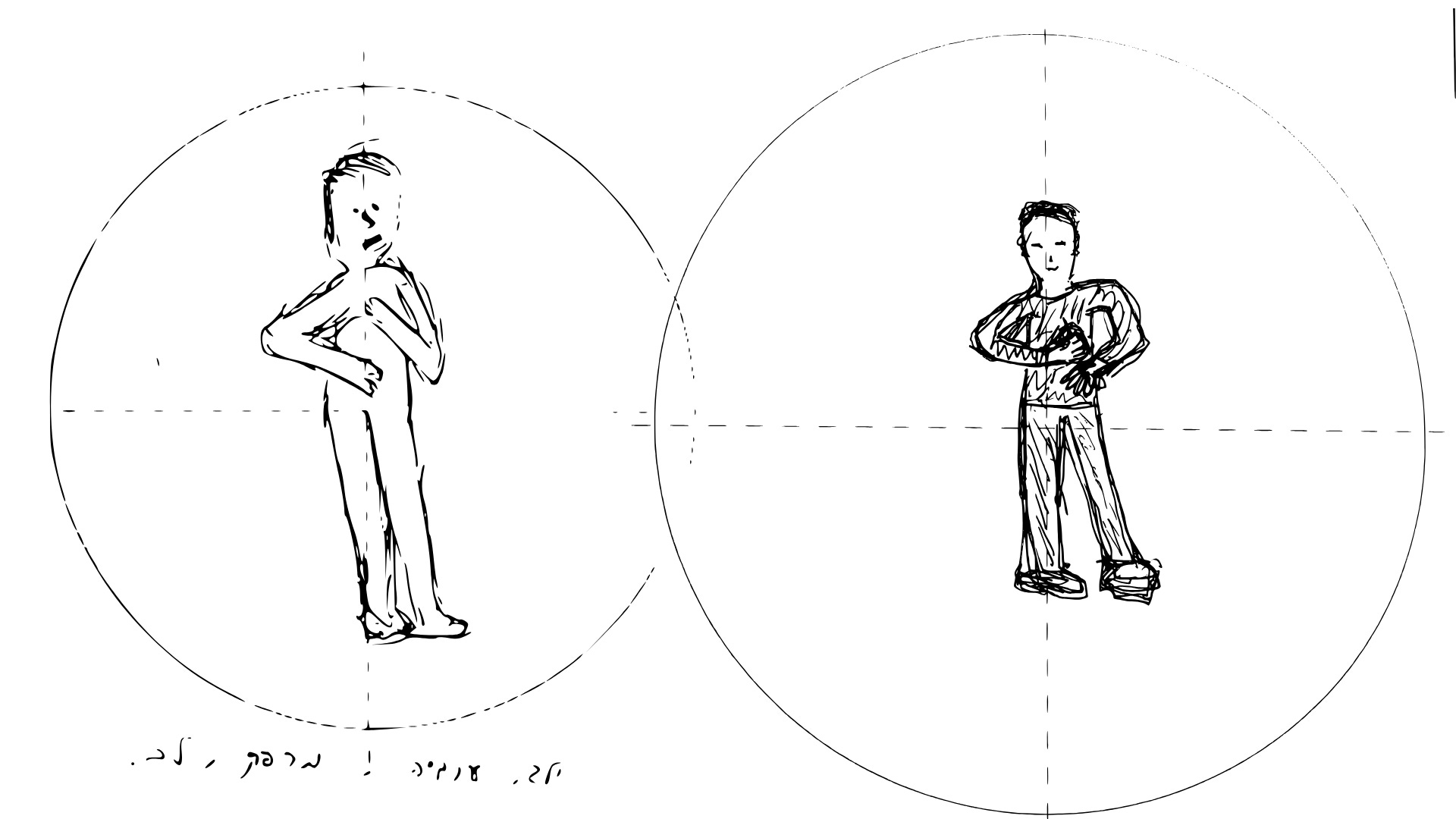
The 1st stuck– My personal story
“One hand to my chest
One hand to the front,
Pushing, protecting… “
“We are not our stuck, stuck it is something we have or wear, like a shirt.”
This wisdom is something Arawana often shares when introducing the stuck practice.
I have tried to start writing this article several times, and each time I got stuck in a fresh way. In the first attempt, I started trying to position and contextualize myself within the writing. But it quickly became yet another version of telling my life story, a kind of reflective biography that I have been trying to get out of my system, but which, in a way, has become part of my system. This makes it clear to me that before I can speak about a global stuck, I need to address my own stuckness: that feeling stuck is “normal”, and that we, in the end, are all “stuck together.”
My stuckness within my own personal story can be mapped into a potential global pattern: the tendency to confuse self-referencing with self-awareness, to become lost in our own story of trauma and ego. Trying desperately, in one way or another, to make someone, or rather anyone, like us. It speaks to that one essential human need of being seen, that one human being the modern “Western” world managed to almost entirely ignore. Our need has become the trigger for the attention economy and the loneliness pandemic.
In Leading from the Emerging Future: From Ego-System to Eco-System Economics (Scharmer & Kaufer, 2013), the authors ask why we collectively create results nobody wants. I feel it is not only that we are enacting outcomes that no single person desires, but that we are wanting what none of us truly needs. Disconnected from our real sources of well-being, we have lost our way.
What if our individual and collective stories, which we are attached to of pain and oppression, are not really who we are or who we could become?
What if we could shift the stories we tell ourselves about oursevles?
How to move through it? What is the next step? Many times I have assumed this stuck position, one hand facing forward, another on the heart, and almost always a shift started when my hands moved away from my chest, expanding to the sides and towards the ground, releasing the tension. The information I got from this stuck shape is the sense that this is an ancestral story, and the “true move” is the one leaning back to the support at my back, that healing is collective.
The 2nd stuck– The technology trap
“My neck is bent forward
My two hands on my head
Pushing down”
In my second attempt at starting to write this piece, I turned to a favorite problem‑solving tool of our age: generative AI and large language models. I gave NotebookLM access to some unpublished drafts of related articles of mine from five years ago. I added the transcripts from a session I recorded last week, I shared the general idea of what I wanted to write about, and asked to draft an article. Some ideas looked very intriguing. The algorithm, as it does, mirrored my requests and my desire to stay grounded and referenced. And yet, the result was not something I recognized. It was not what I wanted to say. While it seemed organized, it was not able to put order into my messy thoughts.
Everything looked polished, but equally to it was soul-less, life-less.
Generative AI lives in our collective human fantasies, the illusory beliefs that what we need is just the perfect tool, the right gadget, a deus ex machina where our machines solve all our problems. The truth is that while machines might be useful to ease our lives, and the progress of the last few years in artificial intelligence's capacity to “simulate” humanness is remarkable, it only embodies the ghosts or degraded copies of the human minds that made/prompted it. New shiny tools can make us lazy, attached to their comfort. I was starting to lose my own capacity to write, as my own messy, yet genuine style of expression. Just as with the printing press, generative AI might give us completely new ways to express and diffuse ideas, but what will be the trade-off? What are the ethical and social challenges it poses?
Arawana often shares as she introduces the Stuck practice: “Stuck is a natural part of the creative process.” It makes me wonder if the AI-disrupted world is a threshold towards something completely different, a part still unfolding process of becoming.
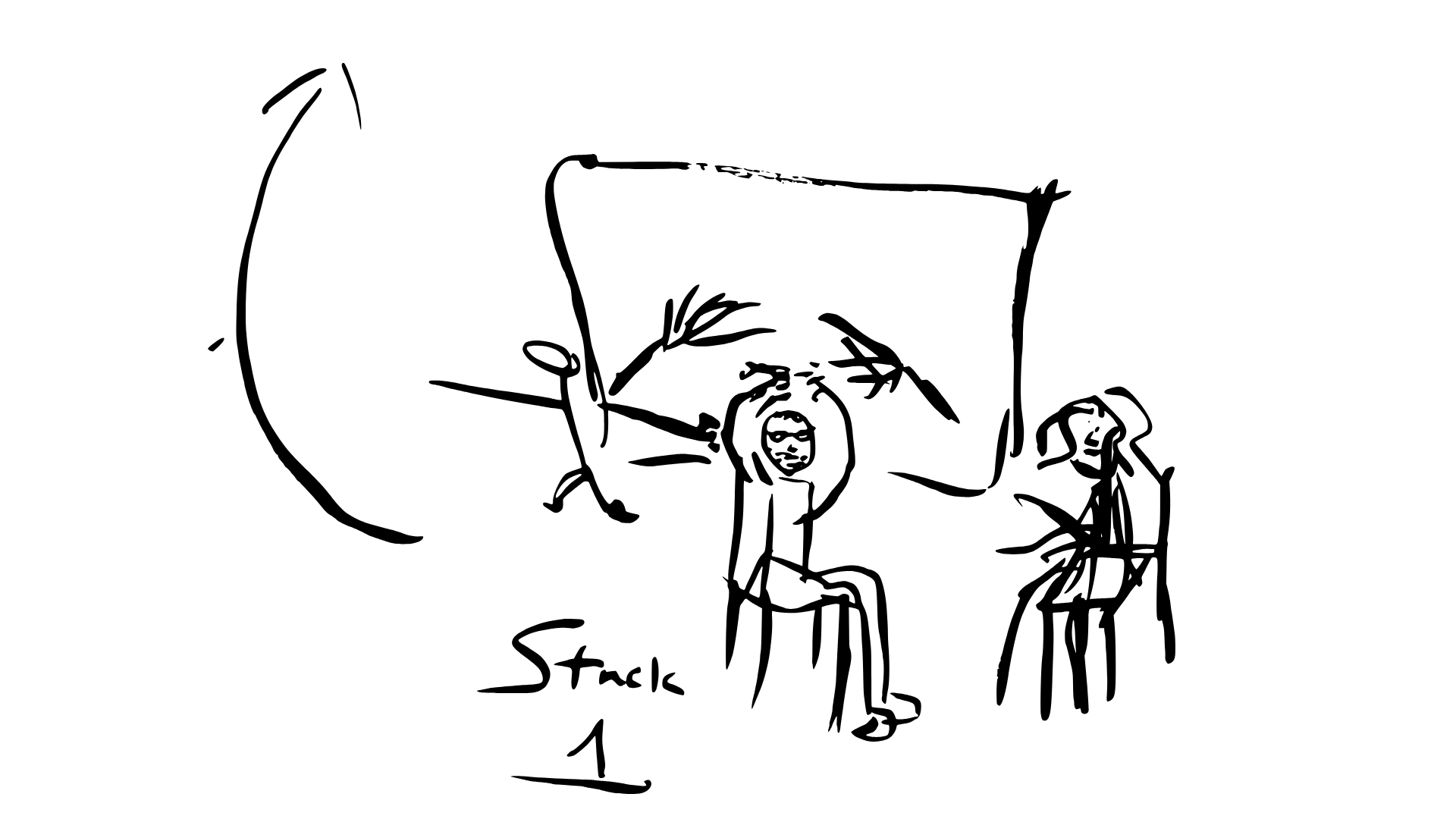
In this stuck shape I have explored many times, my head is between my hands. I recall the first movement that comes to me is the hands going down, sometimes to the heart, sometimes to the ground, and then often it allows the head and sometimes the hands to rise again, open to the world. In the technical stuckness of post-digital worlding, I feel we are invited to go back to the intelligence of the heart and the earth. To let the mental overwhelm of thinking and doing drop to ground, to take the pressure of feeling the world on our backs, and our self-made undoing.
Can we use and make tech to be in the service of life, and not the other way around?
Perhaps this way we could start to source information that is genuine, that is life-supporting, and that can guide us personally and collectively back into a relationship with the whole. With the possibility of connection and life not as mental effort but as an embodied sigh of relief.
The 3rd Stuck – The inner forces
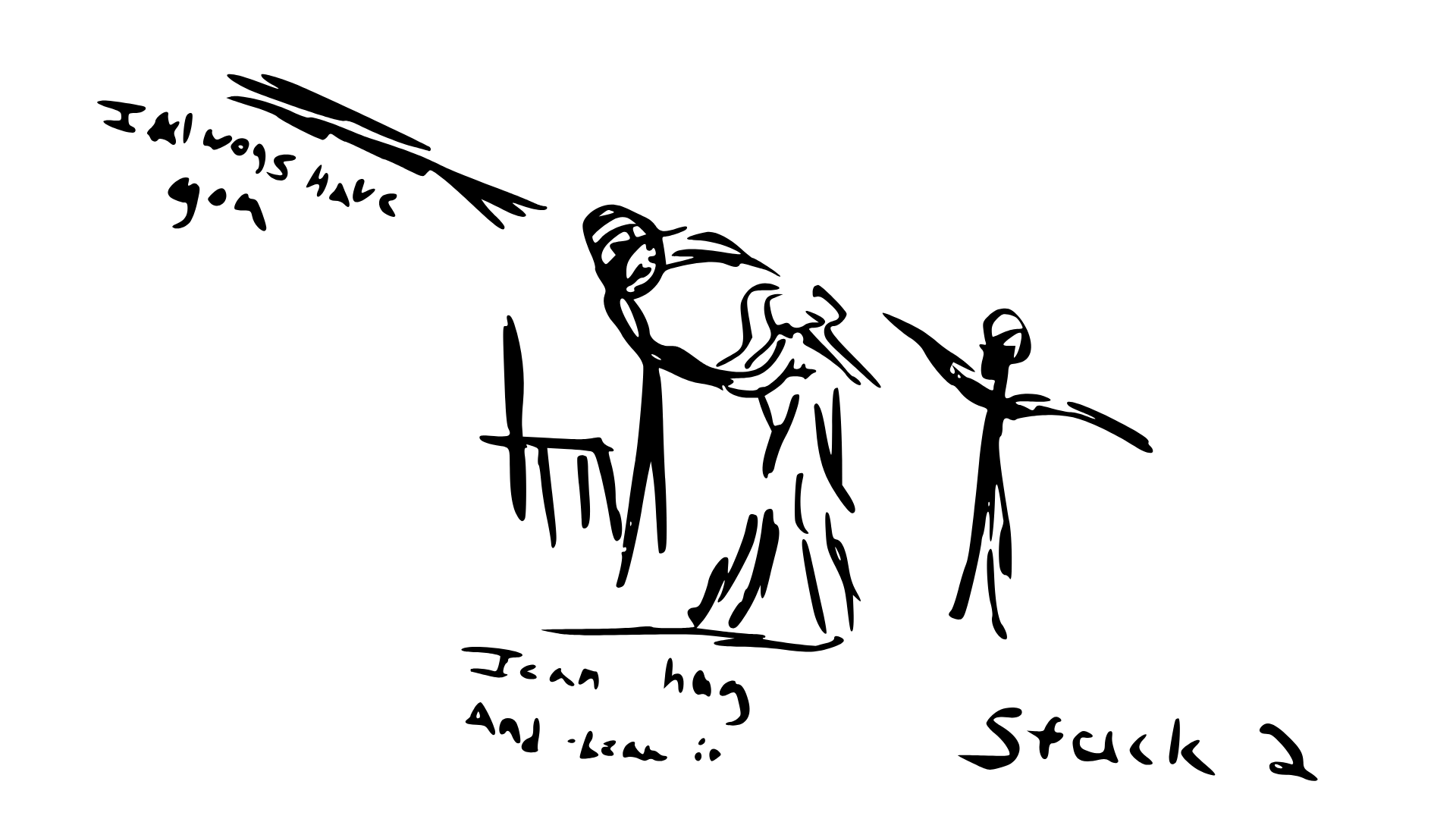
“In front of me, there is one
Beside me there is one,
Where should I turn?”
My third attempt at writing this piece is the one that actually started to get things moving. I was at the family dining table with my laptop before sunrise, before my family woke up for the daily routine of breakfast and school drop‑off. As always for me (and maybe for you), I get my best ideas at times when I should be doing something else, like driving, or in this case, sleeping.
The insights of how to move forward as I was coming in and out of the dream, when we sleep, we can release our mental patterns, patterns that often are holding back from what we are intent on achieving. Our mind gets too crowded, unable to find the thread from which to take the next step. My way out of my writing stuck was simply to write in the flow, to trust whatever comes.
It is liberatory to remember I am not writing to tell the Truth; it is to tell a truth, reflecting on what is happening inside and outside of me at this time. It is through that a window into an inner world, trying to meet the chaos of the outer world. To give my soul space to move and dance with ideas, and with the potential audience of my thinking and my process of becoming.
Arawana often refers to stuck as a “goldmine” to remind us that our stuckness can become a treasure: a resource on our journey to see where we are right now, an imperfect mirror of flow.
As I move forward in my own process of flow, I start to reach and touch the limits of it. I notice my ideas becoming circular. I become, somehow, blinded by my own light, by the brilliance of words. Can being in the “flow” become self-indulgent?
The reminder I can give myself is that it is also a draft, and I am too. That I have the possibility, the option, to give myself a rest, to pause, to let the day begin again. That I can always go back to it, and to gently, lovingly, give myself space to evolve, to grow, to refine it. To build from what was there before and add or remove the pieces that are needed and those that are not.
In many of my stuck shapes, I am caught between forces, one on my left and the front side of me, and another one on my right and the back side. Often when I send into what wants to emerge, the shift becomes the moment I am stepping backwards, that I am no longer in between the forces, my hands spread, and I make space, as if holding the forces, it is not about me at all.
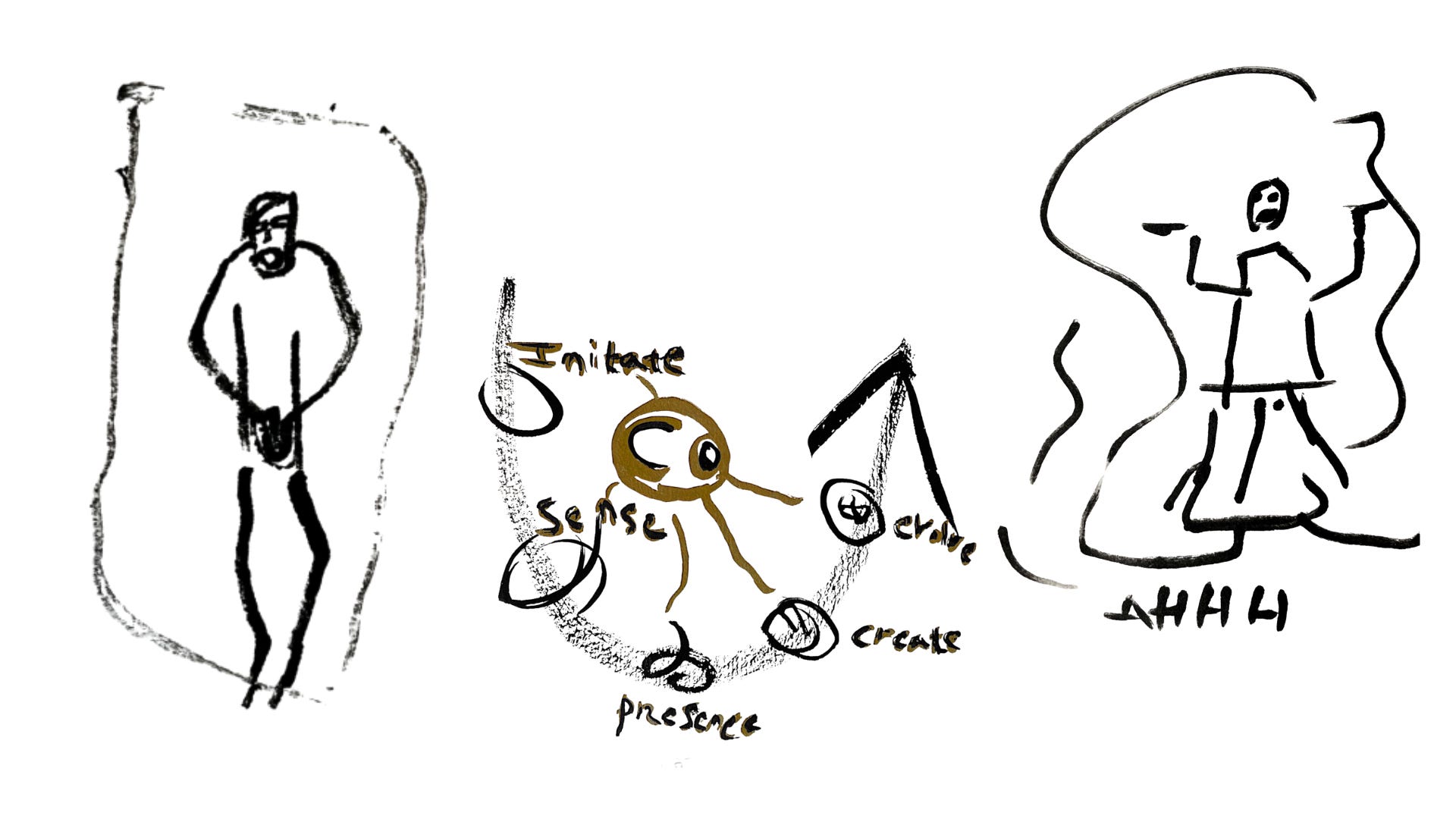
“I want to connect you” is a sentence that I say when I allow this “stuck” to speak.
As I entertain them, my stuck is not only my own. I consider how we could have maneuvered ourselves, collectively, to the position of being caught between past and future, between earth and sky, between duty and joy, to such an extent that we are unable to see that we are meant to be the connectors. To be bridges.
When you welcome this possibility, what insights appear in front of you?
Stuck-types – Dancing with others
“As I look into myself,
As I behold you,
I can Be-come”.
“We are always in social bodies, is one of my favorite sentences from the teaching of Arawana, and I sense the key and the door to understand our global stuckness. We are so highly entangled with one another, and the greatest illusion that capitalism tries to sell is individualism. There is no greater punishment to a human than being disconnected from their collective, from social relating; the worst punishment in prison is solitary confinement. We need each other as much as the air we breathe.
In my teaching of Newspaper Theatre with social work students and educators, I often share two studies to frame our collective challenge:
“Surveys across ten countries found that 75% of young respondents believe ‘the future is frightening.’ - The Lancet Planetary Health
“91% of Gen Z experienced a physical or emotional symptom due to stress and mental illness.” - American Psychological Association
Research, I believe, is not a lone path; it is a landscape. My journey with this work was and always is in relationship with others. My “work” with Theatre that Reconnects, but it is not at all only my work, it is a collective journey with countless interactions and allies, mentors, and partners. It thrives through the interaction of the students and educators who take my courses, through witnessing their digital essays, through reading their reflections, and through seeing myself grow into my educator self.
My young daughters are my greatest mentors, teachers of play and presence. What motivates me to keep weaving, experimenting, and weaving Theatre of the Oppressed and Social Presencing Theater, exploring the stuckness and possible shifts.
A crucial thought partner in articulating the work is Ilaria Olimpico, who is also my life partner. Together, we co-founded TheAlbero artistic collective in 2012 and started to experiment with creative tools and methods that brought these insights into being.
These early experiments we shared in an article on the Process “Image and Stories” we co-authored for a book with a collection of Theatre of the Oppressed practitioners’ essays called “Ensayando el Despertar - Miradas movilizadoras desde el pluriverso del Teatro del Oprimido” curated by Hjalmar Joffre-Eichhorn.
A chapter recently published “Theatre and Stories That ReConnect: Embodiment Practices That Ecologise Masculinities”, we wrote together with Dr. Paul M. Pulé for the book “Feminist Climate Policy in Industrialised States”. It is through our dancing with and around each other that these ideas can be formed.
I am deeply grateful to all whom I danced with and around, to make this work happen.
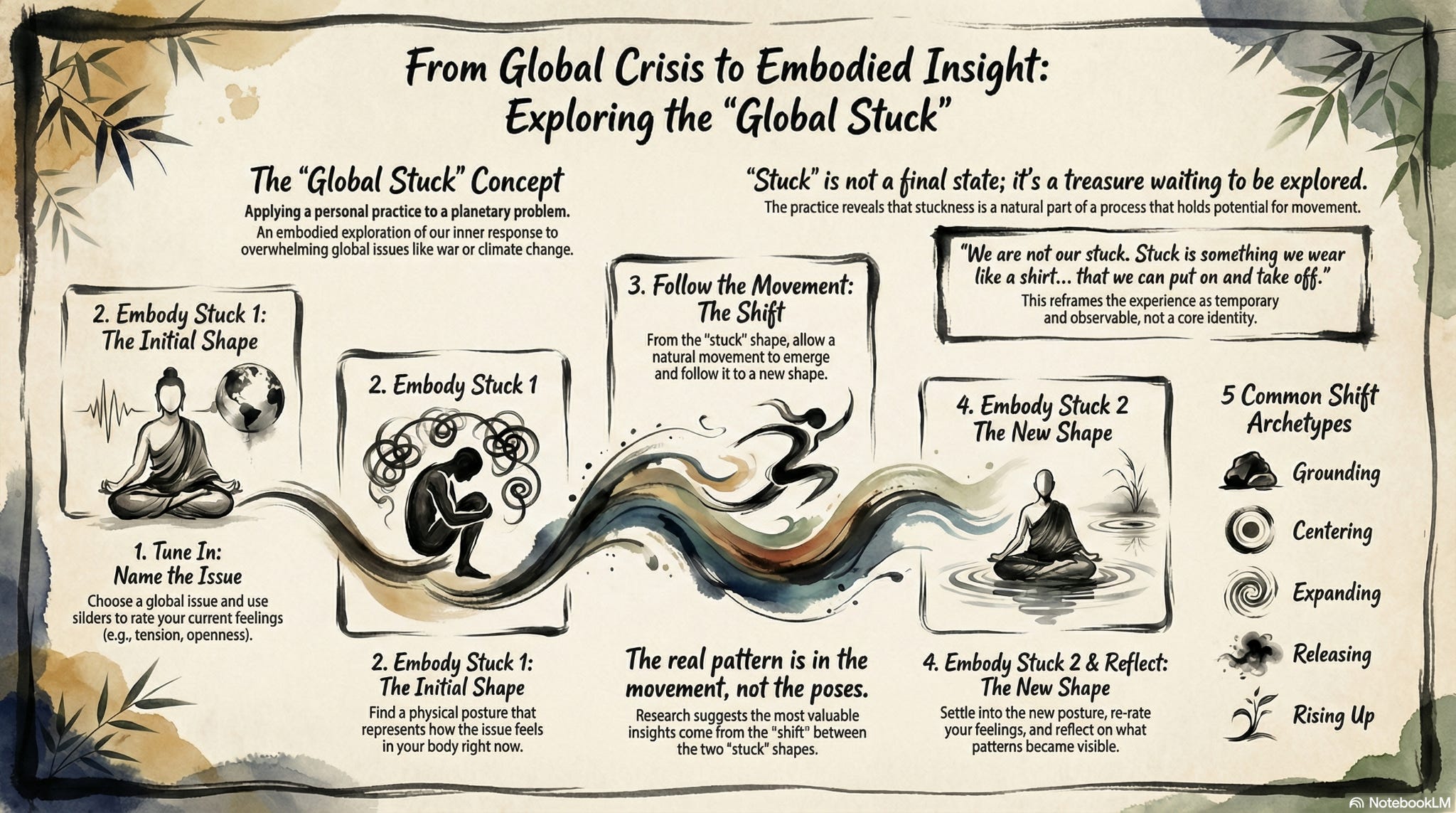
Sense‑making: a global stuck
This article, like the practice itself, remains unfinished. It is a draft, a trace, an opening. For that reason, I will keep editing it and adding invitations to practice and research her below. It is an ongoing inquiry into how we might meet the current moment. I share it as an invitation into a simple, repeatable practice to engage the global stuck as a living question on your own or even better with a group. I offer it as an invitation to stay with what is, to sense a shift, right now in the present moment.
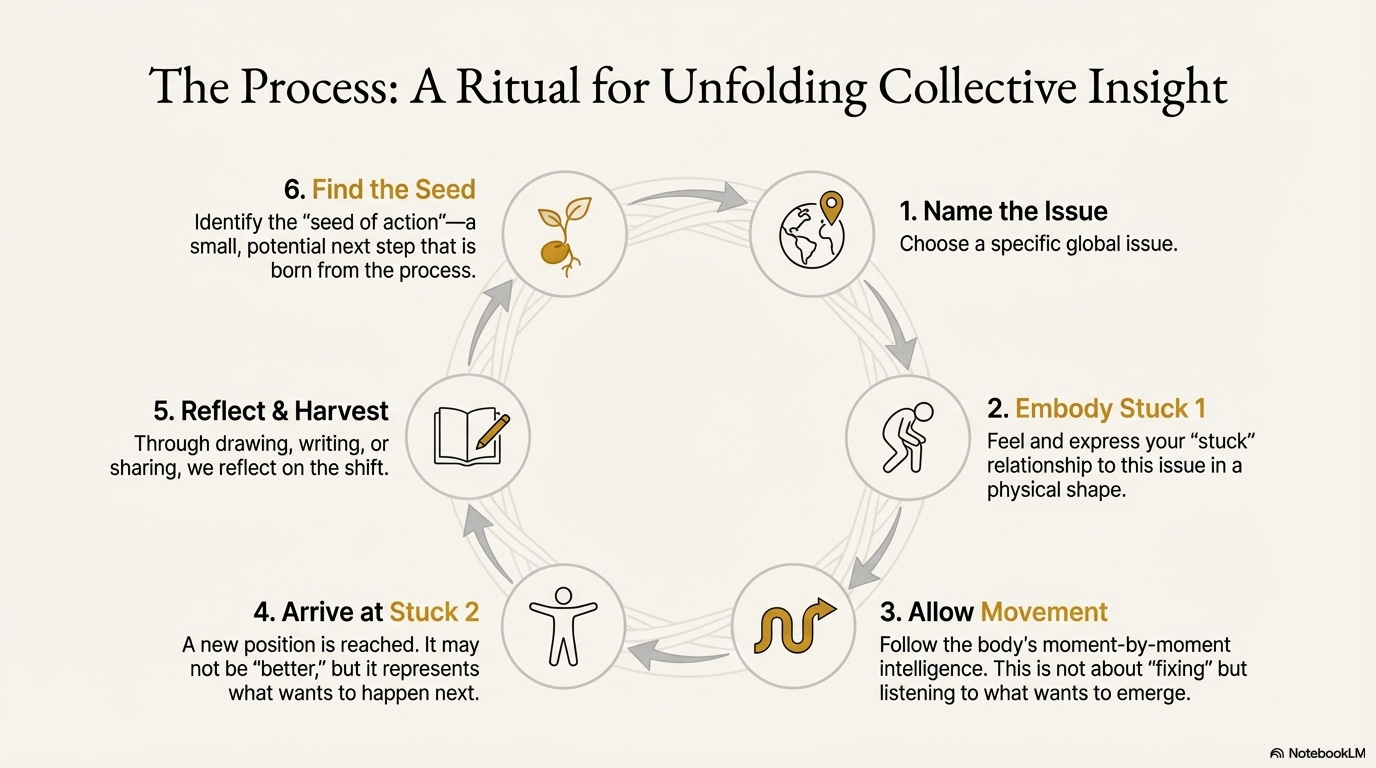
The Global Stuck Practice in Five Steps
1. Choose your focus
Take a moment to choose and name a specific global issue you wish to explore
2. Embody Stuck One
Find a physical posture that expresses how this issue feels as an embodied experience.
3. Allow movement
From Stuck One, allow movement to emerge on its own. Do not try to improve, solve, or get into a particular shape. A core principle of this work is that stuck is not sustainable. Follow the body’s impulses with gentle curiosity. Trust the body system with its own way of knowing.
4. Arrive at Stuck Two
At some point, the movement will arrive at a new position—Stuck Two. It may not feel better or resolved. It points towards a possible next step, a prototype.
5. Reflect and share
After the movement, take time to reflect—ideally with others. This can include:
Drawing the shapes of Stuck One, Stuck Two, and the shift between them.
Sharing lived experience and insights that arose during the movement.
Find a seed of action, asking what small gesture might look or be like.
Your input to the collective research
Upcoming Events & Invitations
Theatre that Reconnects Facilitators’ Training
🗓 February 16 - February 19, 2026
This course is a live, practice-based learning journey for those ready to lead group processes rooted in presence and collective action. Grounded in Social Presencing Theatre, The Work That Reconnects, and Theatre of the Oppressed, this one-week intensive (Feb 16–19) provides a practical map for adapting theatre methodologies to real-life social and cultural contexts.
👉 Application Link:luma.com/pkassl4b
*I now offer a Fellowship offering with up to 12 pay-what-you-can scholarships for leaders committed to implementing these tools in their context over the next year.
Theatre that Reconnects Practice Space
🗓 February 26, 2026
The Practice Space is a “living laboratory”, a low-pressure, embodied environment designed to keep the spirit of collective intelligence alive. It is the perfect entry point for those who want to take it “step-by-step” or stay fresh in their practice.
👉 Registration Link: luma.com/hkt80brx
Theatre that Reconnects IN
🗓 April 9 - May 7, 2026
A new Introduction Course specifically designed for those who want a formal grounding in Theatre That Reconnects before moving into advanced training.
👉 Registration Link: www.tickettailor.com/events/uriyitzchaknoymeir/2048774